
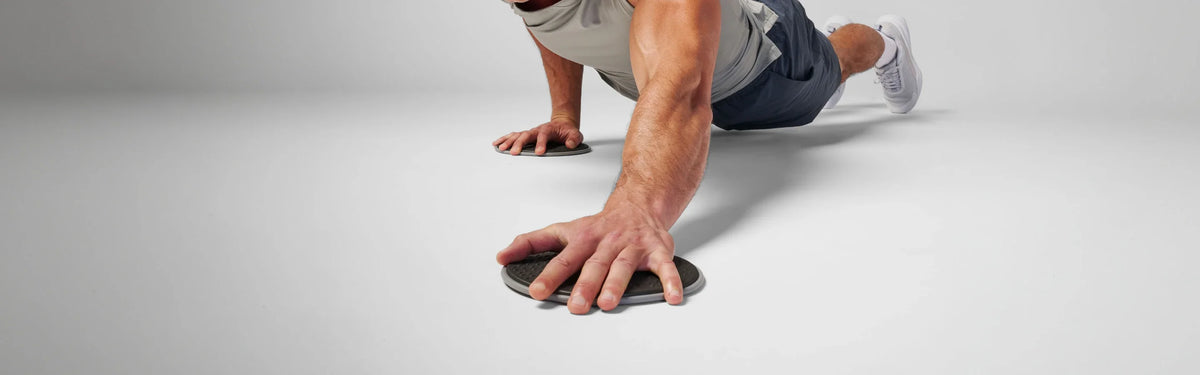
Close-up of hands on gray textured EQYP disc sliders during a plank exercise on the floor.

Balance Discs & Sliders

Instability tools that engage stabilizer muscles and sharpen balance, coordination, and control.

Filters

Sort by:

2 products

Woman performing a kneeling contralateral balance reach on EQYP Balance Disc with one arm extended forward, front-angle viewEQYP Balance Disc in slate blue showing embossed non-slip texture pattern and EQYP logo on top surface
Balance Disc Sale Price$29.99
Man performing a sliding bilateral chest fly in a plank position using EQYP Sliding Discs under both handsTwo EQYP Sliding Discs showing dark gray textured surface with embossed EQYP logo and gray edge rim
Sliding Discs Sale Price$32.99

Balance Discs & Sliders

These instability tools create an unstable surface that forces your stabilizer muscles to engage, building balance, coordination, and core control. Balance discs and sliding discs each challenge stability in a different way — one static, one dynamic.

Choose Your Tool

  • Balance disc: dual-textured, air-filled disc for standing balance drills.
  • Sliding discs: low-friction discs for lunges, mountain climbers, and glide-based core work.

Balance discs work best for static standing balance drills, while sliding discs are better suited to dynamic, glide-based movements like lunges and mountain climbers.

Frequently Asked Questions

Find answers to common questions about EQYP Fitness Products.

What's the difference between a balance disc and a sliding disc?

A balance disc is an air-filled cushion you stand or sit on to challenge stability in a fixed position, while sliding discs have a low-friction surface designed to glide across the floor for dynamic movements.

What exercises use sliding discs?

Common sliding disc exercises include mountain climbers, reverse lunges, pike slides, and lateral lunges, all of which use the low-friction surface for controlled gliding movements.

Can balance discs help with ankle rehab?

Yes. Balance discs are commonly used in physical therapy to rebuild proprioception and ankle stability after a sprain or other lower-body injury.

What floor surfaces work best with sliding discs?

Sliding discs work best on hardwood, tile, or other smooth, hard flooring. They don't glide effectively on carpet.

How much weight can a balance disc hold?

Most balance discs are rated to support standard adult body weight for standing and kneeling exercises — check the specific product for exact weight limits.

Are balance discs good for beginners?

Yes. Simple exercises like standing on one foot or gentle weight shifts are accessible starting points before progressing to more dynamic balance challenges.